
Multifunctional Furniture has transitioned from being a quirky novelty found in tiny-house documentaries to becoming an essential pillar of modern interior design. I remember my first apartment in the city—a studio so small I could practically touch both walls if I stood in the middle and stretched my arms. Back then, I viewed every piece of furniture as a singular entity with a singular purpose. A bed was for sleeping, a table was for eating, and a sofa was for sitting. It did not take long to realize that this traditional mindset was a recipe for a cluttered, unbreathable living environment that hindered my productivity and peace of mind.
The true magic of versatile design lies in its ability to adapt to the changing needs of the person living within the space. We no longer live in a world where rooms are used for only one activity throughout the day. Our living rooms have become offices, our bedrooms have become gyms, and our kitchens have become social hubs. To keep up with this fluid lifestyle, our surroundings must be equally flexible. This is where the brilliance of clever engineering meets aesthetic appeal, allowing a single square foot of floor space to serve multiple purposes without looking like a chaotic storage unit.
When we talk about the evolution of these pieces, we are looking at a sophisticated response to the global trend of urbanization. As more people move into major metropolitan hubs, the average size of a dwelling is shrinking while the cost of that space is skyrocketing. This economic reality has forced designers to think outside the box, or rather, to rethink the box entirely. It is about creating a symbiotic relationship between form and function where neither is sacrificed for the sake of the other. It is about finding the “hidden” potential in every armrest, hollow base, and foldable surface.
The Living Room Revolution and Multifunctional Furniture Benefits
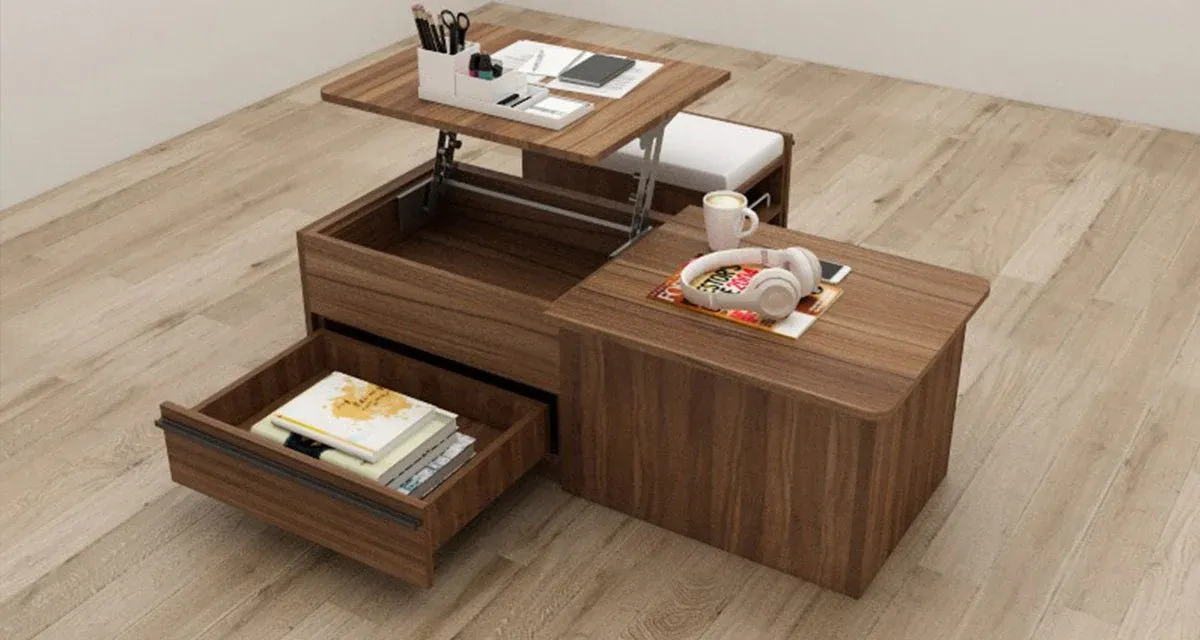
The living room is perhaps the most demanding space in any home, requiring a delicate balance between relaxation and social interaction. Incorporating Multifunctional Furniture in this area can completely change the energy of the room from cramped to inviting. Consider the humble coffee table, which traditionally serves as little more than a resting place for magazines and mugs. Modern versions now feature lift-top mechanisms that raise the surface to dining or desk height, revealing hidden storage compartments for laptops and chargers. This simple transformation allows a relaxing lounge area to become a fully functional workspace in seconds.
I once worked with a client named Julian who was an avid book collector living in a one-bedroom loft. He struggled with the choice between a massive sofa for guests and a sprawling bookshelf for his collection. We solved this by choosing a modular sofa system with integrated shelving built into the back and side frames. This allowed him to showcase his library while maintaining a sleek, modern seating area. By treating the furniture as a structural element of the room rather than just an accessory, we maximized every inch of his available square footage without making the space feel like a library annex.
Another staple of the versatile living room is the ottoman with hidden storage. It serves as a footrest, extra seating during a party, and a trunk for blankets or board games. These pieces are particularly effective because they are easily movable, allowing for a dynamic layout that can be rearranged depending on the occasion. When you choose pieces that can “pinch hit” in different roles, you eliminate the need for specialized furniture that only gets used once or twice a year, freeing up your floor for movement and light.
Mastering the Home Office with Smart Multifunctional Furniture
The rise of remote work has turned the home office from a luxury into a necessity, but not everyone has a spare room to dedicate to a desk. This is where the “cloffice” or the hidden desk comes into play. A wall-mounted cabinet that folds down into a sturdy desk surface is a prime example of how Multifunctional Furniture solves a modern dilemma. When the workday is done, the desk folds up, the laptop disappears, and the room returns to its identity as a bedroom or dining area. This physical act of “closing” the office is also vital for mental well-being, helping to maintain a clear boundary between professional and personal life.
In my experience as a consultant for small-space living, the most successful home offices are those that are integrated into existing structures. I’ve seen bookshelves where one shelf is slightly deeper and set at the perfect ergonomic height to act as a permanent desk. This utilizes vertical space that would otherwise be underused while providing a dedicated area for productivity. It is about identifying the “dead zones” in your home and reclaiming them with intention. When furniture is designed to be multipurpose, it encourages a more organized way of living because every item has a specific place where it belongs.
Trustworthy design in this category also considers the technical requirements of modern devices. A desk that doubles as a console table is only useful if it includes integrated cable management and power strips. Without these features, the “multifunctional” aspect is undermined by a tangled mess of wires that creates visual clutter. The highest quality pieces prioritize these details, ensuring that the transition between roles is seamless and aesthetically pleasing. It is this attention to the user experience that separates a professional-grade piece from a cheap imitation.
The Bedroom Sanctuary and Hidden Efficiency
The bedroom should be a place of tranquility, but it often becomes a dumping ground for laundry, shoes, and seasonal clothing. Storage beds are the unsung heroes of the bedroom, utilizing the massive amount of space beneath the mattress that is traditionally wasted. Whether it is a hydraulic lift system that raises the entire mattress or a series of deep drawers built into the base, these beds provide the storage capacity of a full-sized dresser without taking up any additional floor space. This allows for a more minimalist look in the rest of the room, which has been shown to improve sleep quality by reducing visual distractions.
Wall beds, or Murphy beds, have also seen a massive resurgence in recent years, far surpassing the clunky, dangerous versions seen in old comedies. Today’s wall beds are precision-engineered pieces of Multifunctional Furniture that often include integrated sofas or desks on the front. During the day, the bed is a stylish couch or a wide workspace; at night, it lowers effortlessly to reveal a high-quality mattress. This technology has allowed studio apartment dwellers to enjoy the benefits of a “real” bedroom without sacrificing their living area. It is a game of architectural sleight of hand that creates two rooms in the space of one.
I recently visited a friend who had moved into a micro-apartment in Tokyo, a city that has mastered the art of compact living. Her bed was raised on a platform that contained her entire wardrobe in sliding wardrobes underneath. The stairs leading up to the bed were also drawers for her shoes. This vertical approach to furniture design is a powerful reminder that we should not just look at the floor plan, but at the volume of the room. When you start thinking in three dimensions, the possibilities for efficiency become virtually limitless.
Dining and Kitchen Versatility for the Modern Host
The kitchen and dining areas are often the most difficult to manage in small homes because dining tables take up a lot of room and are only used for a few hours a day. Extendable dining tables that can shrink down to a small console or expand to seat eight people are a classic example of versatility. However, the modern version of this includes kitchen islands on wheels that can serve as a prep station, a breakfast bar, or a serving buffet during a party. When furniture can move with you, it becomes a tool for better living rather than a static obstacle.
In many urban apartments, the “dining room” has vanished entirely, replaced by a multifunctional kitchen island. By choosing stools that can tuck completely under the counter, you keep the walkway clear when not in eating mode. Some innovative designs even feature a dining table that slides out from underneath the kitchen counter, providing a dedicated eating surface only when needed. This prevents the “dining table clutter” where the table becomes a magnet for mail, keys, and miscellaneous items because it is always there taking up space.
Aesthetics are just as important as mechanics in these high-traffic areas. A table that transforms needs to look just as beautiful in its small form as it does when fully extended. This requires expert craftsmanship and high-quality materials that can withstand the friction of moving parts. When I evaluate a piece for a client, I look closely at the hinges, the glides, and the locking mechanisms. A piece of Multifunctional Furniture is only a good investment if it is built to last through thousands of transformations. If the mechanism fails, you are left with a piece of furniture that is stuck in one mode, defeating the entire purpose of the purchase.
Sustainability and the Economic Case for Better Design
Choosing furniture that serves more than one purpose is also a significant step toward a more sustainable lifestyle. By purchasing one high-quality piece instead of two or three cheap, single-purpose items, you are reducing your overall consumption and the carbon footprint associated with manufacturing and shipping. This “fewer but better” philosophy is at the heart of conscious consumerism. It encourages us to invest in quality and longevity rather than disposable trends that end up in a landfill after a few years.
From an economic perspective, while a piece of versatile furniture might have a higher upfront cost than a standard item, it often saves money in the long run. If you don’t have to buy a separate desk, a guest bed, and a storage trunk because one or two pieces cover all those needs, your total expenditure is actually lower. Furthermore, these pieces can increase the “rental value” of a small apartment. A landlord who furnishes a studio with smart, versatile pieces can often command a higher rent because the tenant is getting the functionality of a much larger space.
Expertise in this field also involves understanding the materials used. Solid woods and high-grade metals are essential for pieces that have moving parts. Cheaper materials like particle board often cannot handle the stress of being folded, lifted, or slid on a daily basis. When you are shopping, ask about the weight capacity and the warranty on the moving components. A reputable manufacturer will stand behind their engineering, providing peace of mind that your investment will serve you for decades rather than just months.
The Psychological Impact of an Organized Home
There is a profound psychological benefit to living in a home that feels spacious and organized. Clutter is not just a physical problem; it is a mental one. When our environment is filled with too many objects, our brains are constantly processing that visual noise, which can lead to increased stress and decreased focus. Versatile furniture allows us to hide the “visual clutter” of our lives—the paperwork, the extra linens, the hobby supplies—leaving us with a clean, calm environment that promotes relaxation.
The act of transforming a room also provides a sense of agency and control over our environment. There is something deeply satisfying about folding away your desk at the end of a long day and watching your office disappear. It is a physical ritual that signals to your brain that it is time to rest. This ability to “reset” our space helps us to be more present in whatever we are doing, whether it is working, sleeping, or spending time with loved ones. Our homes should support our mental health, and a versatile layout is one of the most effective ways to achieve that.
In my years of studying interior psychology, I have found that people who live in adaptable spaces tend to be more creative and flexible in other areas of their lives. When you are not fighting against your furniture, you have more energy to dedicate to your passions. You are no longer limited by the physical boundaries of your rooms because you have learned how to expand those boundaries through smart design. It is a liberating way to live, proving that you don’t need a mansion to have a life that feels large and full of possibility.
Choosing the Right Pieces for Your Lifestyle
When selecting versatile pieces, the first step is to be honest about your daily habits. Do you actually host overnight guests, or would a daybed that serves as a reading nook be more useful? Do you really need a massive dining table, or would an expandable one that stays small most of the week be better? Many people make the mistake of buying furniture for the life they think they “should” have rather than the life they actually live. The most effective furniture is the kind that makes your actual daily routine easier and more enjoyable.
Measure your space meticulously before you buy. Many versatile pieces require “clearance zones” to transform. A wall bed needs space to lower, and an extendable table needs room for chairs on all sides when it is open. I always suggest using painter’s tape to mark out the dimensions of the furniture in both its “open” and “closed” states on your floor. This gives you a realistic sense of the flow of the room and prevents you from buying a piece that is technically functional but practically impossible to use in your specific layout.
Authoritativeness in home styling is about knowing when to go custom and when to buy off-the-shelf. For very awkward spaces, like under a sloped ceiling or in a tiny alcove, a custom-built piece of Multifunctional Furniture might be the only way to truly maximize the area. While more expensive, a custom solution can solve multiple problems at once, such as providing storage, seating, and a room divider in one integrated unit. For standard rooms, however, there is an incredible array of high-quality ready-made options that can suit almost any aesthetic, from mid-century modern to industrial chic.
The Future of Adaptive Living and Tech Integration
As we look toward the future, we are seeing the integration of technology into furniture in even more profound ways. We already have sofas with built-in USB ports and coffee tables with integrated Bluetooth speakers. The next step is the rise of “robotic furniture,” where entire walls move at the touch of a button or a voice command. Imagine a single room that can transform from a bedroom to a living room to a walk-in closet automatically. While this technology is currently in the high-end luxury market, it will eventually become more accessible as the demand for smart, micro-living continues to grow.
This tech-forward approach is not just about gadgets; it is about making the furniture even more responsive to our needs. Sensors can adjust the height of a standing desk based on who is using it, or lighting can change automatically when a bed is lowered to create a sleep-conducive environment. The goal is to create a home that is an active partner in our well-being. When technology and furniture work together, the result is a living space that feels almost intuitive, anticipating our needs and adapting to our movements.
Even without high-tech robotics, the future of design is clearly moving toward more modular and portable systems. We are seeing a trend toward furniture that is “nomadic,” meaning it is easy to disassemble, move, and reconfigure in a new home. This reflects the reality of a modern workforce that moves more frequently. When your furniture can grow and change with you as you move from a studio to a house and back again, it becomes a lifelong companion rather than a disposable commodity.
Creating a Cohesive Look with Versatile Pieces
One common concern is that versatile furniture might look “mechanical” or “industrial,” but that is no longer the case. Some of the most beautiful designer pieces on the market today are also some of the most functional. The key to creating a cohesive look is to choose a consistent color palette and material language throughout the room. If your wall bed has a sleek white finish, your lift-top coffee table should have a similar modern aesthetic. When the “transforming” elements are tucked away, the pieces should look like high-quality, stationary furniture.
Balance is also important. Not every piece in your room needs to be multifunctional. If you have a few key “workhorse” pieces that handle the heavy lifting of storage and versatility, you can afford to have a few purely decorative items that bring personality and soul to the space. This prevents the room from feeling like a showroom for gadgets and makes it feel like a real home. It is about the layering of textures, colors, and functions to create a rich, lived-in environment.
Ultimately, the journey toward a more efficient home is a deeply personal one. It is an opportunity to look at your life and decide what really matters to you. Do you value space for yoga, a dedicated area for your creative hobbies, or a place where you can comfortably host your friends? Whatever your priorities, there is a piece of furniture that can help you achieve them. By embracing the versatility of modern design, you are not just saving space; you are expanding the potential of your life.
Your home is the foundation of your world, and it should be as dynamic and resilient as you are. Whether you are living in a tiny studio or a large family home, the principles of versatile design can help you create a space that is more organized, more peaceful, and more joyful. It is a commitment to quality, a celebration of innovation, and a smarter way to live in the 21st century. The walls of your home may be fixed, but with the right furniture, the possibilities within those walls are endless.